

Most people think of stress as a psychological problem…
A busy week at work.
Financial pressure.
Relationship difficulties.
A traffic jam.
But those things aren’t actually stress. They’re stressors. Stress is your body’s response to stressors. And one of the very first ways your body responds is by changing its level of tension. Perhaps you’ve noticed it yourself.
Your shoulders gradually creep upwards.
Your neck feels tight by the end of the day.
You find yourself clenching your jaw without realising it.
Your breathing becomes a little shallower.
There’s a general assumption these are simply unavoidable consequences of modern life. But they’re not. They’re signs that your nervous system doesn’t feel safe.
Your Body Evolved to Adapt
Human beings possess an extraordinary ability that allowed our species to survive through hundreds of thousands of years of natural challenges…
We adapt.
Every moment of every day, there’s a part of your nervous system working automatically in the background, taking in information from your world with the simple biological imperative:
“How do I survive? What do I need to do to stay safe?”
Sometimes that response is move.
Sometimes it’s stay still.
Sometimes it’s heightened awareness.
Sometimes it’s to protect.
At least it was, back when your nervous system evolved these primal responses to stay safe. Without this ability to adapt and survive, none of us would be here.
Sometimes your nervous system gets the answer right. Sometimes modern life overwhelms it. That doesn’t mean its faulty.
We Evolved for a World that No Longer Exists
For most of human history, our nervous systems evolved in natural environments…
A threat appeared.
Your body prepared a response to keep you safe.
The situation passed.
Your body settled again.
That cycle was remarkably effective. Today, however, many of us spend our lives adapting to environments that look very different. I often simply describe that difference as:
“We evolved for the jungle, but we live in a human zoo”
Instead of occasional life threatening events, our nervous system experiences constant stimulation.
Emails.
Deadlines.
Traffic.
Financial pressure.
Interrupted sleep.
Information overload.
Social disconnection.
Our nervous systems are incredibly adaptable. But they’re now being asked to adapt to challenges that didn’t exist in nature and often don’t have a clear beginning or end.
When Protection Doesn’t Switch Off
You don’t consciously decide to tighten your neck, shoulders, your lower back or hips.
Your nervous system adjusts the tone and tension throughout your whole body in response to what it believes is happening around you. In the short term, that’s incredibly intelligent.
Tension can help stabilise you.
Prepare you.
Protect you.
The difficulty arises when those automatic protective responses stay “switched on” long after they’re no longer needed. Over time, your body can become so accustomed to living in protective patterns that they simply begin to feel normal. It’s not broken, it’s simply become stuck in protection.
Why the Spine Matters
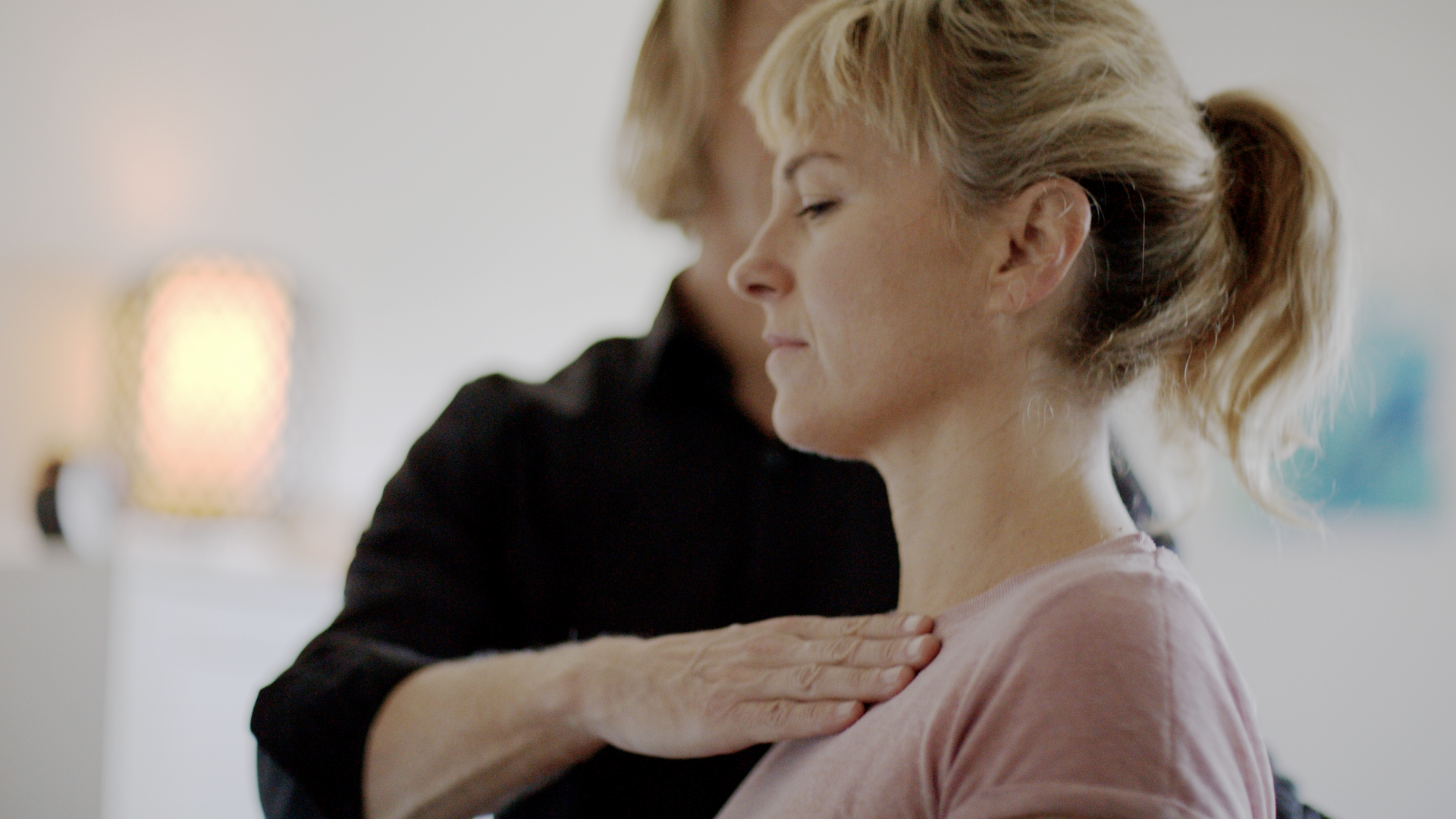
Stress is a whole-body response. One of the first places your protective patterns become observable is through the spine. The muscles supporting your spine respond almost immediately as your nervous system adapts to what’s happening around you.
Your posture shifts.
Your breathing changes.
Movement alters.
Even before you are aware of the change, your body is different. That’s one of the reasons we pay such close attention to the spine. Not necessarily because the spine is the underlying problem. But because it’s an important indicator of how your nervous system has been responding to its world. Your spine is “the canary in the coalmine”
Looking Beyond the Symptoms
Over time, persistent protective patterns may contribute to experiences such as:
neck and shoulder tension
back pain and headaches
reduced movement
fatigue
poor sleep
tight breathing
feeling “tired but wired”
difficulty relaxing
feeling constantly “on edge”
It’s understandable to think of these conditions as the problem and seek to fix them all separately. But it’s highly likely they are occurring secondary to something deeper…
You’re not broken; you don’t need to be fixed
It may just be that your system is stuck in protective patterns that are past their use-by date.
A Different Way of Thinking About Healing
At Foundation, we don’t see the body as something that needs to be forced into change. We see it as a remarkably intelligent system that is continually trying to adapt.
Our role is to work with that intelligent system, helping it become more aware of the protective patterns it has been holding and then teaching it how to let those patterns resolve.
As this happens, many people notice positive shifts in multiple secondary conditions such as tension, pain, breathing, more energy, movement, emotional regulation and their overall sense of wellbeing.
Not because we are treating each of those things individually. But because a nervous system that is less stuck in stress is now free to organise itself in more adaptable, healthy ways.
The Bigger Picture
Perhaps the most encouraging thing I’ve learned over the last sixteen years helping people in Mona Vale and across Sydney’s Northern Beaches is this:
Your body is not the enemy. It has spent your entire life trying to protect you. The question isn’t whether your nervous system is intelligent. It is.
The real question is whether the strategies it learned to keep you safe in nature are still the best ones for the life you want to live today.
The remarkable thing about the human nervous system is that it never stops learning. It never stops adapting. And when given the opportunity, it can discover new ways of responding that allow greater freedom, more energy and a fuller expression of the life that’s already within you.
In my experience… that’s what healing really looks like.
Discover More
If parts of this article felt familiar… If you’ve been living with persistent tension, recurring pain, poor sleep, feeling constantly “on edge”, or simply a little “stuck”, it may be worth exploring whether your nervous system is still carrying protective patterns that no longer serve you.
Sometimes the first step towards healing isn’t more “fixing”. It’s finally understanding what your body has been trying to do for you all along.
If this article has helped you see your own experience in a new light, I invite you to explore more. Whether you have more questions, you’re considering starting care, or it’s time to return for another tune-up, you’re always welcome to get in touch.
We offer a Complimentary Introductory Consultation. A no-obligation conversation to discuss your concerns and learn more about how we can help.
With Love,
Andrew Maher.
NeuroStructural Chiropractor.